
BTO vs Resale Flat Renovation: Which Costs More, and Why Does It Cost More?
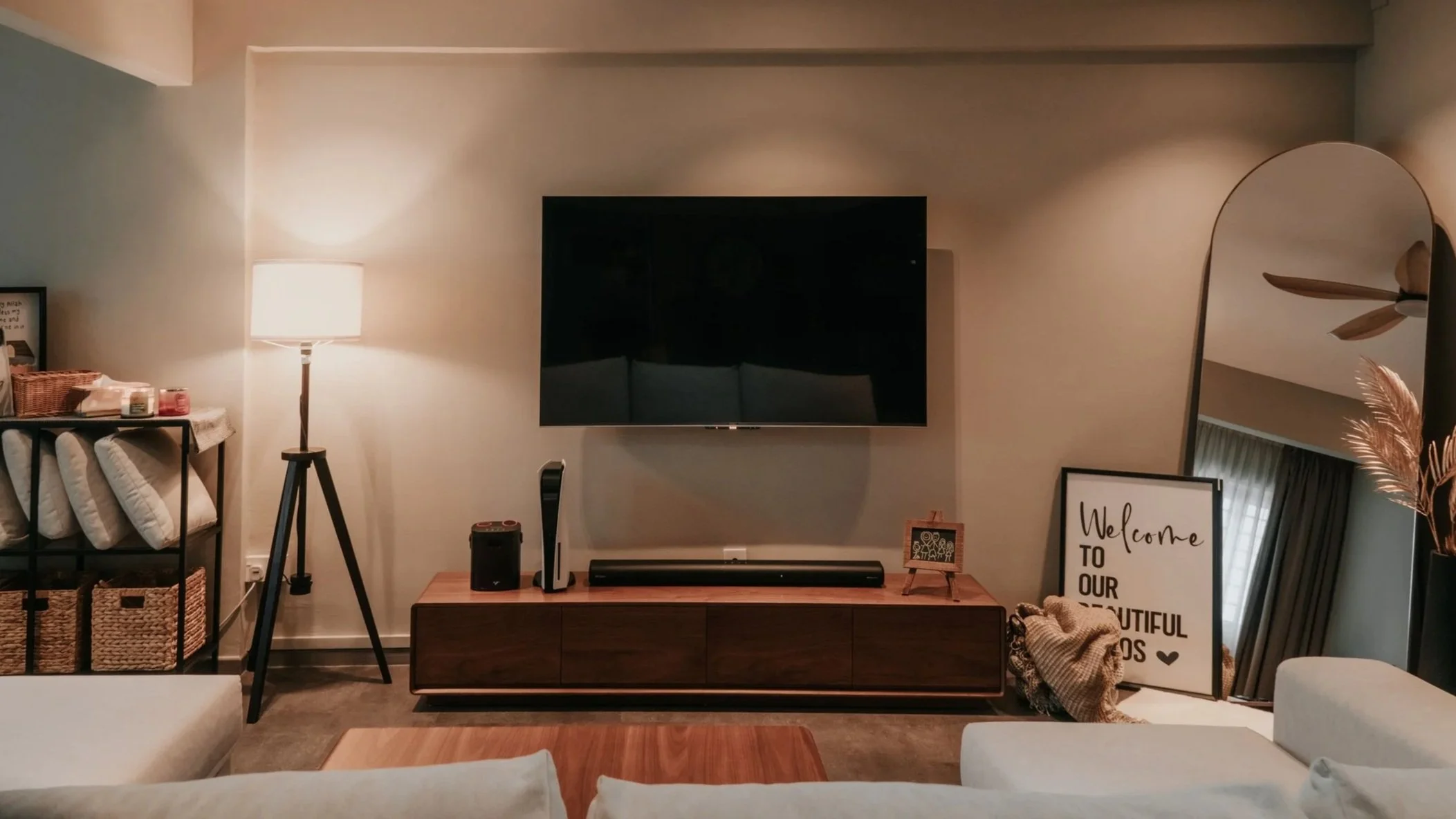
A modern living room featuring a ceiling fan, large TV, and decorative mirror.
The Big Question Every Singapore Homeowner Asks
You've finally gotten your HDB flat — congratulations! Now comes the fun part: renovation. And the slightly less fun part: figuring out how much it's all going to cost.
If you're doing your research (good on you), you've probably noticed that the internet is full of renovation quotes that range from "surprisingly affordable" to "wait, how much?!". One of the biggest variables? Whether you're renovating a BTO or a resale flat.
Spoiler alert: resale flats almost always cost more to renovate than BTOs — typically by 20 to 30%. But the more important question is why, and whether that gap applies to your specific situation. Because sometimes, a BTO reno can end up costing just as much as a resale. (We'll get to that too.)
Let's break it all down — with real numbers, real cost drivers, and some honest advice on how to budget smarter for each property type. This is your no-nonsense guide to HDB renovation costs in Singapore for 2025–26.
The Numbers First: BTO vs Resale Renovation Costs by Flat Type
Before we get into the "why", let's look at the "how much". These are typical ranges for full renovations managed by an interior designer or renovation contractor in 2025–26. Note that these figures cover renovation works only — furniture and loose appliances are a separate budget conversation.
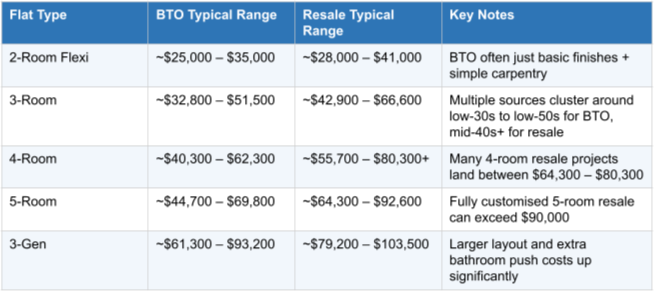
BTO vs Resale Renovation Costs by Flat Type
A few things worth noting: renovation prices have risen roughly 5–10% heading into 2025 compared to a few years ago, thanks to material and manpower inflation. So if you've been bookmarking renovation posts from 2019 or 2020 and thinking those budgets still apply — they probably don't. Those figures are likely off by a five-figure amount.
Why Resale Renovations Cost More: The Line-by-Line Breakdown
The gap between BTO and resale renovation costs isn't just a vague "older flat" premium. There are very specific, concrete reasons why resale renovations tend to run more expensive — and understanding them helps you budget properly.
1. Hacking and Demolition: The Cost of Starting From Scratch
This is the big one. Before any beautiful new finishes go in, you need to rip out the old ones. Resale flats come with existing flooring, wall tiles, built-in carpentry, sanitary fittings, doors — all of which need to be removed and hauled away before the real work even begins.
For a standard resale flat, hacking and demolition alone can add roughly $3,000 to $6,000 to your total bill. Here's how it breaks down by area:
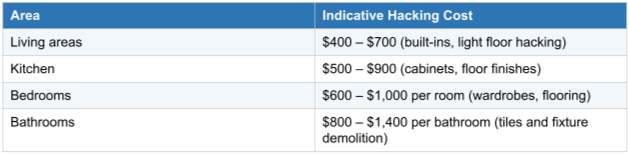
The Line-by-Line Breakdown
BTOs skip this phase almost entirely. That's a potential saving of $2,000 to $4,000 before you've even chosen your tiles. Not bad.
2. Rectification and Structural Issues: The Hidden Costs
Older resale units often come with age-related problems that absolutely must be fixed before you can lay down those gorgeous new floors. We're talking spalling concrete, ceiling and wall cracks, hollow tiles, and water seepage — issues that can easily add $500 to $2,000 or more depending on severity.
Some older flats also need floor re-levelling or new screed before new tiles or vinyl can go down properly. This is work that a new BTO simply doesn't require (especially within its first few years), and it's the kind of cost that many homeowners don't anticipate until the contractor points it out mid-renovation.
3. Plumbing and Pipe Upgrades: An Unglamorous But Necessary Cost
Here's something that doesn't make it onto many Instagram renovation posts: for older resale flats, HDB often requires replacement of aging iron pipes with copper — both for safety reasons and to prevent leaks.
Pipe replacement for an entire flat typically costs around $1,500 to $3,500, depending on layout and the number of bathrooms. For a BTO, your plumbing system is brand new and HDB-compliant, so you're typically only spending on fixture upgrades, vanity carpentry, and aesthetic finishes rather than ripping out and replacing the whole system.
4. Electrical Rewiring and Compliance: Modern Life Needs Modern Wiring
Many resale units — especially those that haven't been recently upgraded — have outdated wiring and far too few electrical points for how we live today. Think about all the things that need power in a modern home: smart appliances, EV charging points, home office setups, lighting tracks, air conditioning.
Full or heavy electrical rewiring, plus adding sufficient points for all of this, can cost from about $1,200 all the way up to $17,000 or more for extensive work in larger flats. For a BTO, the wiring is new and HDB-compliant, so owners typically only need to add points and adjust lighting locations — significantly cheaper than ripping out old trunking and circuits.
5. Wet Areas: The Bathroom Situation
Resale bathrooms almost always require new waterproofing, re-tiling, and replacement of aged sanitary fittings. This is more invasive (and expensive) than it sounds. The traditional hacking and re-waterproofing method for a single bathroom can cost around $1,500 to $3,000 or more, and typically takes one to two weeks.
BTO bathrooms, on the other hand, already come with HDB-installed waterproofing and tiles. Many owners simply change the vanity, shower screen, and tapware to personalise the space. If they choose to retile, they're essentially paying to remove something brand new — which brings us neatly to the next section.
When BTO Renovations Get Expensive: Don't Get Too Comfortable
BTO is cheaper by default. But — and this is an important but — your design ambition can erase that cost advantage pretty quickly.
You Hack Out All the HDB-Provided Finishes
Here's the thing: HDB provides your BTO with basic flooring, bathroom tiles, and kitchen cabinets as part of the Optional Component Scheme (OCS). If you accept these and work with them, you save a lot of money. If you decide you hate them all and want to start from scratch? You're essentially doing resale-level demolition work on a new flat — and you can end up spending $55,000 to $70,000 or more on a 4- to 5-room unit. Similar to many resale budgets.
You Go Heavy on Custom Carpentry and Designer Finishes
Extensive carpentry — platform beds, full-height wardrobes, feature walls, concealed doors, custom display niches — combined with premium materials can push a 5-room BTO renovation into the $65,000 to $75,000 bracket in 2025. That's territory where the BTO advantage starts to look a lot smaller.
You're Adding Smart Home and Audio/Visual Systems
Advanced lighting systems, multi-room audio wiring, smart home automation, and integrated AV setups all add significant cost on top of the base BTO fit-out. These upgrades are great, but they chip away at the BTO price advantage every time you add one.
Where Does the Money Actually Go? A Component-Level Look
Let's get specific. Whether you're doing a BTO or resale renovation, the same broad cost categories apply — they just hit very differently depending on your situation.
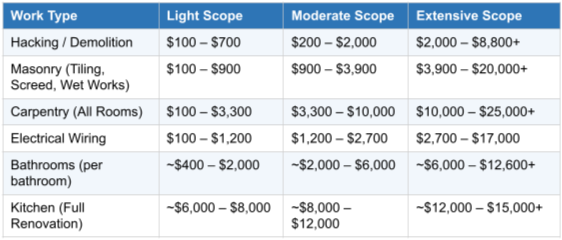
A Component-Level Look
Masonry and carpentry are consistently the top two cost drivers in any renovation. If you're trying to control your overall renovation budget, these are the areas where your design choices will have the biggest financial impact.
Two Real-World Scenarios: A Tale of Two 4-Room Flats
Sometimes the best way to understand renovation costs is to see how they play out in practice. Here's a rough comparison of two common renovation approaches for a 4-room HDB flat.
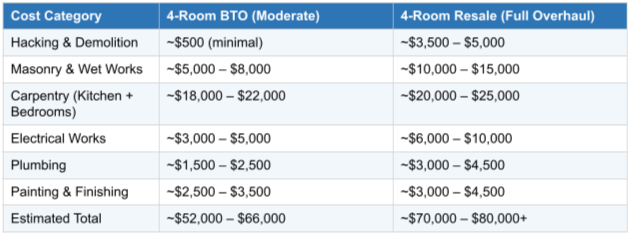
A Tale of Two 4-Room Flats
The BTO scenario assumes the homeowner keeps HDB-provided flooring and bathroom tiles, and focuses spending on kitchen carpentry, built-in wardrobes, and updated electrical points. The resale scenario involves full hacking, retiling throughout, rewiring, and pipe upgrades — which is standard for a comprehensive resale renovation.
How to Budget Smartly for Each Property Type
Knowing the numbers is one thing. Knowing how to use them is another. Here's how to approach budgeting differently depending on whether you're doing a BTO or resale renovation.
For BTO Homeowners: The Case for Restraint
Your biggest advantage is that HDB has done a lot of the groundwork for you. Use it.
Keep the HDB-provided OCS finishes if they're decent. Replacing brand-new tiles and cabinets is throwing money away.
Focus your custom carpentry budget on high-impact, high-use areas: the kitchen and master bedroom wardrobe. Use quality ready-made furniture for secondary bedrooms and the living room.
Don't go overboard on built-ins in every room. Each additional custom piece adds cost and extends your timeline.
Always keep a 10–15% contingency fund. Surprises happen even in new flats.
If you want smart home upgrades, plan your electrical works alongside them from the start — this avoids duplicate labour and ensures compatible wiring.
For Resale Homeowners: Prioritise the Right Things
Your renovation is more complex, so budgeting needs to be more methodical.
Get your pipes, wiring, and waterproofing checked early. Addressing structural or system issues upfront prevents far more expensive problems later.
Retain any resale fixtures that are still in good condition. Re-laminating existing carpentry is far cheaper than replacing it entirely.
Overlay tiles where you can, rather than hacking and re-tiling. This saves on hacking costs and timeline.
Prioritise wet areas (kitchen and bathrooms) in your budget — these are the hardest and most expensive to redo after the fact.
Phase your renovation if your budget is tight: do the wet works and structural upgrades first, then tackle cosmetic and soft furnishing upgrades later.
Absolutely set aside a 10–15% contingency fund. With resale flats, unexpected issues are practically a tradition.
Budget Allocation Guidelines: A Rough Framework
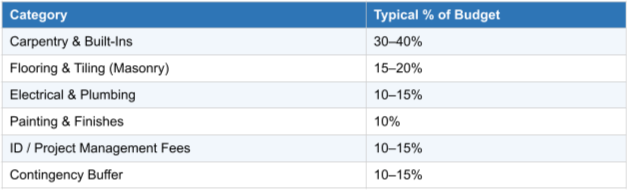
A Rough Framework
Beyond the Dollars: Other Factors That Matter
The renovation cost difference between BTO and resale isn't just about money. Here are a few other considerations worth factoring into your decision.
Time and Inconvenience
Resale renovations take longer — typically 8 to 12 weeks compared to 6 to 10 weeks for BTOs — primarily because of hacking, rectification, and the time needed for approvals. That means more weeks of paying for temporary housing or commuting from your parents' place. Factor that into your total cost calculation.
On the flip side, BTOs come with their own timing challenge: you might wait several years from ballot to key collection before you even start renovating. But HDB's one-year Defect Liability Period (DLP) means that minor defects in a new BTO flat are covered, whereas in a resale flat, you're fully on the hook for whatever you discover post-purchase.
Layout Flexibility
Many homeowners choose resale flats specifically for mature estate locations, larger spaces, or unique layouts — corner units, bigger kitchens, balconies. But reconfiguring these layouts often means more hacking and masonry, which pushes up cost. BTO layouts are more standardised, and most owners work within the given layout, directing their budget toward finishes and built-ins instead.
Long-Term Value
A well-renovated resale flat in a prime location can absolutely justify higher upfront renovation costs if you're in it for the long haul. For first-time homeowners on tighter budgets, a simpler BTO renovation paired with quality loose furniture can be a smarter financial strategy — you can always upgrade the finishes later when your finances are in a better place.
BTO Renovation Costs Lesser Generally
Let's be clear: this isn't really a question of which is "better". Both have their renovation cost profiles, and both can deliver a beautiful, functional home. What matters is understanding the cost differences upfront so you can plan accordingly.
BTO renovations are cheaper by default — and that advantage is real and meaningful, often amounting to $20,000 to $30,000 in savings on larger flat types. But that advantage shrinks quickly if you hack out all the HDB-provided finishes and go heavy on custom carpentry.
Resale renovations cost more — but often for legitimate, unavoidable reasons: aging infrastructure, decades-old tiles and wiring, and the need to bring everything up to modern standards. Understanding these costs helps you negotiate better, plan smarter, and avoid nasty surprises mid-project.
Whichever path you're on, the single most important thing you can do is work with an experienced interior designer who is upfront about costs, understands HDB regulations inside and out, and helps you prioritise your budget where it matters most.
Your dream home is absolutely achievable. It just helps to go in with eyes wide open — and a very solid contingency fund.
